
About the case
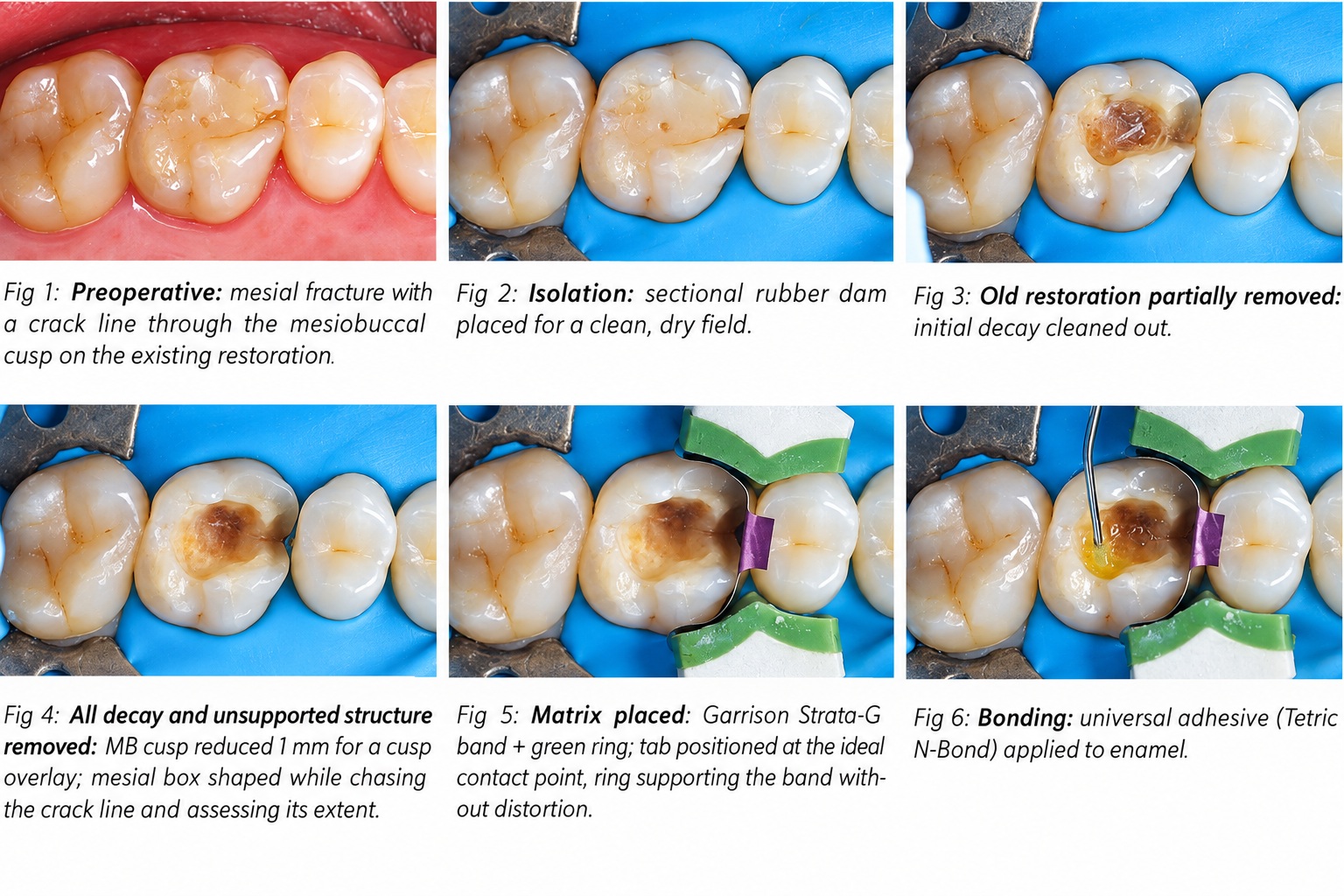
Upper left first molar (tooth 26). The patient presented with sensitivity and instability on biting on the upper left. On examination, the 26 showed a mesial fracture with a cracked mesiobuccal cusp, and the radiograph revealed secondary decay in the mesial area beneath the existing restoration.
The treatment decision was to replace the failing restoration and overlay the cracked mesiobuccal cusp — incorporating it into the new restoration for support rather than leaving the crack to propagate. A direct composite restoration using Tetric N-Plus, bonded with Tetric N-Bond and shaped with the Garrison Strata-G sectional matrix system.
Step-by-step + key points
1. Isolation — The tooth was isolated with rubber dam for a clean, moisture-controlled field.
2. Caries removal & cusp reduction — The old restoration was removed and the secondary decay fully excavated. The
mesiobuccal cusp was reduced by ~1 mm to overlay and protect the cracked segment.
Key point: overlaying the compromised cusp reinforces it instead of leaving a crack to fail later.
3. Surface prep & bonding — The prep was sandblasted with 50 μm aluminium oxide and cleaned of all residual decay for
an optimal bonding surface, then bonded with Tetric N-Bond.
4. Matrix setup — Garrison Strata-G — A 5.5 mm sectional band, green extra-wide sectional ring, and small yellow
wedge sealed the cervical margin and set up the ideal emergence profile.
Key point: the band’s aggressive curvature builds predictable, natural contour and a tight 3D contact — and the tab points
directly at the future contact point.
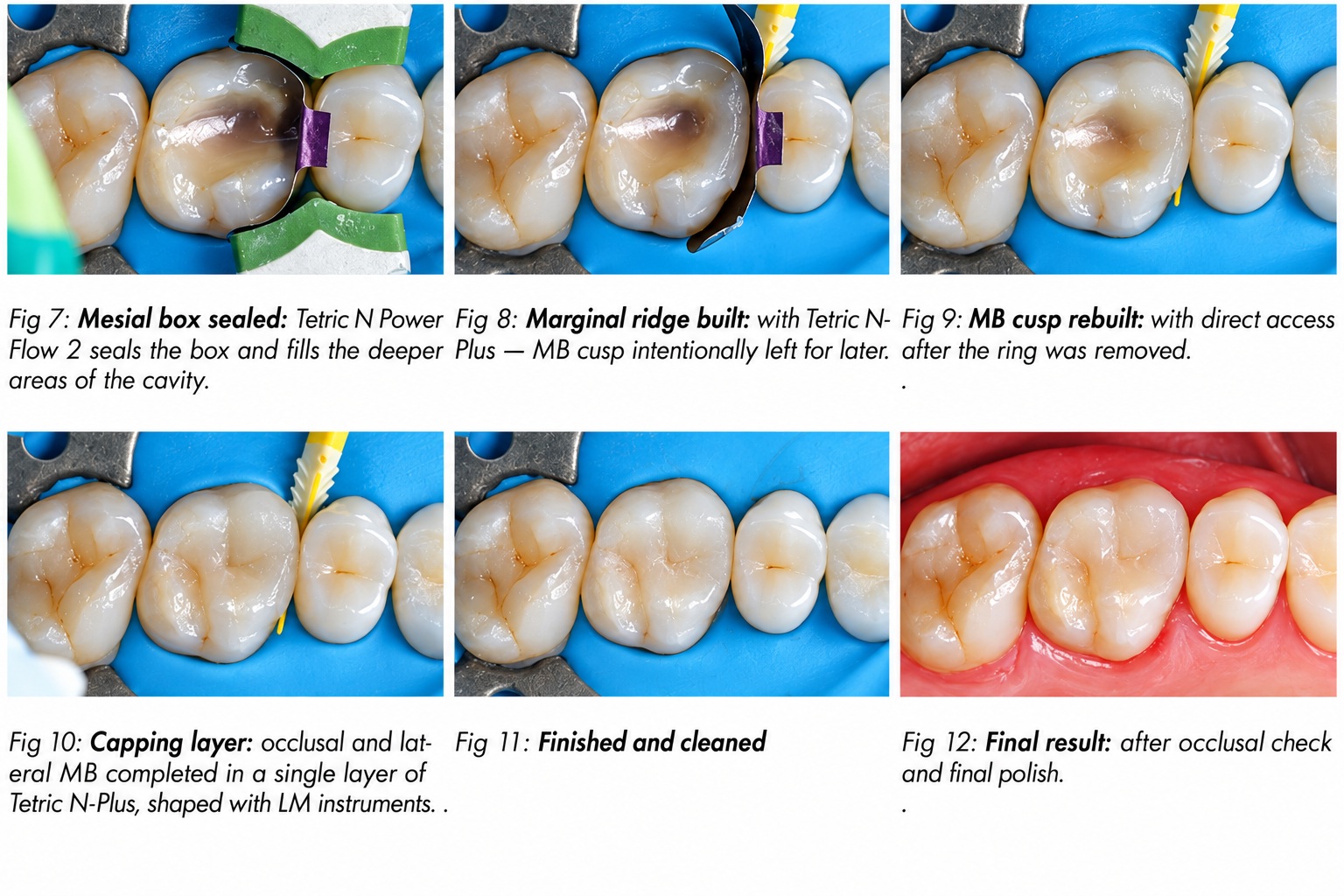
5. Mesial box — bulk flowable — The mesial box was filled first with a bulk-fill flowable (Tetric N Power Flow 2).
6. Rebuild the marginal ridge — The mesial marginal ridge was rebuilt and shaped with Tetric N-Plus to establish the ideal
contact and ridge — only the marginal ridge at this stage, not the cusp.
7. Rebuild the MB cusp separately — With the ridge set, the ring was removed and the mesiobuccal cusp was accessed
and rebuilt directly.
Key point: separating this step gives far better access and a more predictable cusp shape.
8. Occlusal bulk — The bulk of the occlusal defect was filled with the bulk-fill flowable (Tetric N Power Flow 2).
9. Capping layer & anatomy — A final capping layer of Tetric N-Plus was carved with LM instruments (LM condenser and
fissura) to sculpt ideal anatomy.
10. Finish — Occlusion checked, finished and polished to a functional, natural-looking result.When the treatment was
complete, the inlays integrated well into the natural environment.
Summary
A strong, natural-looking restoration with anatomy built for predictable, ideal function — and the cracked cusp protected under an overlay. Building the marginal ridge and the mesiobuccal cusp as separate steps gave better access and a more controlled result, while the Garrison Strata-G system delivered a tight, anatomically correct contact and clean cervical seal.
Published in Int Dentistry- INTERNATIONAL DENTISTRY – AFRICAN EDITION VOL. 16, NO. NO. 4 AUGUST/SEPTEMBER